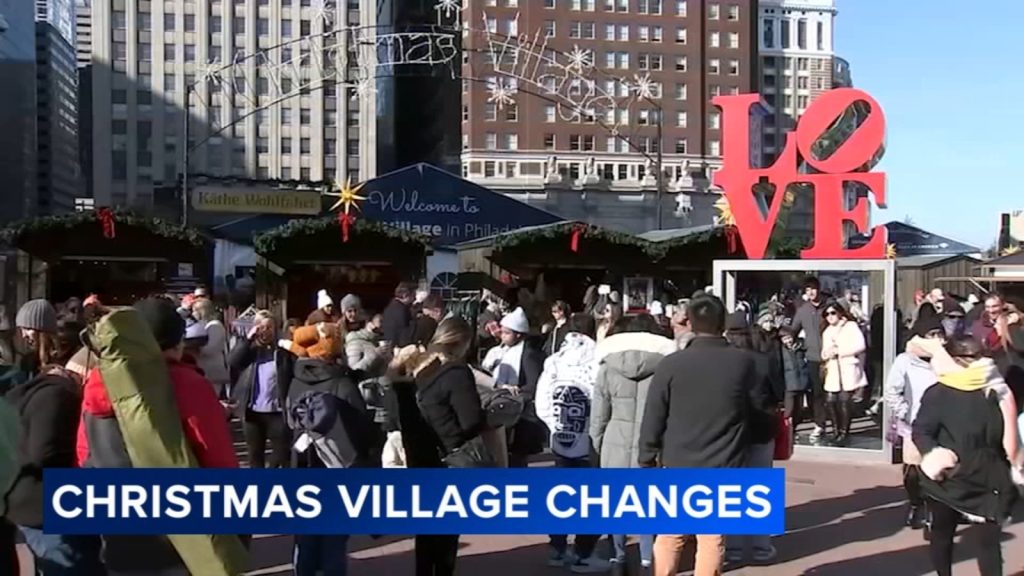


Philadelphia Christmas Village organizers have told vendors that walk-in booths will be eliminated this holiday season, citing the need to bring every kiosk at LOVE Park and City Hall into full compliance with the Americans with Disabilities Act. German American Marketing, Inc., the company that operates the village and the Made in Philadelphia Holiday Market, detailed the accessibility changes in a letter obtained by Action News.
The background
Philadelphia’s Christmas Village draws on the centuries-old German Christkindlmarkt tradition and has become a seasonal fixture in Center City, with rows of wooden vendor kiosks arranged across LOVE Park and the Dilworth Plaza area near City Hall. The federal Americans with Disabilities Act, signed into law in 1990, has governed access at public events for decades, and event operators have worked to retrofit their layouts to meet those standards.
The proposed Philadelphia Christmas Village changes
According to the letter, German American Marketing said it had worked last season to bring the village into ADA compliance but concluded the changes it made were not suitable for everyone. The company then proposed permanent ramps for the upcoming holiday season.
“The ramps would need to be 8′ long with handrails for each kiosk,” the letter to vendors states.
The company acknowledged the practical problem with that approach.
“We don’t want to go into details, but obviously there is no space in the existing walkways, and blocking the entire fronts with handrails will keep foot traffic away from the front of vendor booths. Additional considerations of crowd management and overall event safety are clearly not making this a viable option.”
The only option, according to the company, is to make all booths “inaccessible” to walk-in customers. An entrance barrier will be placed at the front of each booth, and vendors will present their products to shoppers from behind the counter.
How vendors are responding
Lindsay Gradel, the creator of the children’s clothing line Sew Much Cooler, set up shop at the Christmas Village two years ago. She told Action News the booths currently do not meet federal accessibility standards.
“There is a step when people come into the booth, so it’s not ADA-compliant.”
Gradel said she is not returning to the market for several reasons. After being notified of the changes in store for this season, she spoke with other vendors who are concerned about the financial impact.
“It costs $8,000 to $9,000 for a booth, depending if you’re at Dilworth or LOVE Park. They decided it’s too much of a risk. We don’t know how our sales are going to be without people being able to walk in to smell our candles, to try on our jewelry, to try on a sweatshirt.”
“Every customer at the holidays, they want to go into the store, and they want to shop. It’s part of it.”
In his letter, Thomas Bauer, the President & CEO of German American Marketing, addressed the trade-off directly.
“While I suspect most of you will conclude that it’s an equally worse experience, we really have no other viable option. This is the solution the City feels comfortable with from a legal perspective. We are not overly excited, but decided to offer an experience that is in 100% compliance without having to find out through litigation.”
Drew Fisher, who owns the bath and body products company Color & Flame Handmade, said he will not return after three years at the village.
“Just the way that we organically interact with the customer. The way the customers find things. People just want to walk in and experience it on their own terms,” Fisher said.
He said he wished he had learned of the changes earlier in the year.
“There are other shows we could have done. And if we found out earlier, we could have applied to them. It’s too late now.”
German American Marketing said there will be a select few locations where permanent ramps will be possible for businesses to “open up.” Action News reached out to both the marketing company and the city for comment and was waiting to hear back at the time of publication.

Leave a Reply